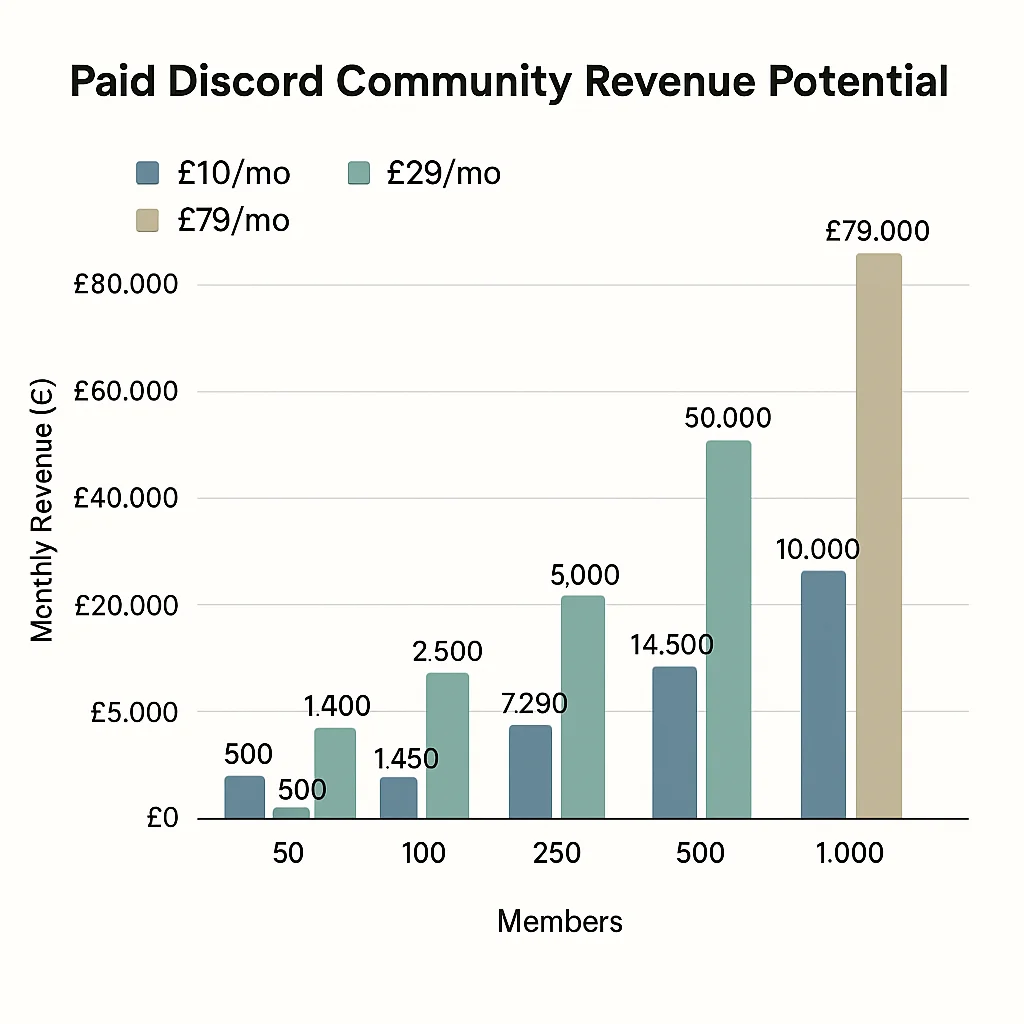
Before you spend months building a paid Discord community, it's worth knowing what the economics actually look like. Not the aspirational case studies — the realistic numbers for communities at different stages, in different niches, with different price points and churn rates.
Here's an honest answer to how much paid Discord communities make, what drives the range, and what the ones doing serious revenue are doing differently.
Real Income Ranges: What Paid Discord Communities Actually Earn
The revenue range across paid Discord communities is enormous — from a few hundred dollars a month to well over $100,000 MRR. The variables that determine where you land are niche, price point, and monthly churn rate.
| Community Size | Typical Price Range | Monthly Revenue (MRR) | Annual Revenue | Key Challenge |
|---|---|---|---|---|
| Small (50–150 members) | $10–$49/mo | $500–$5,000 | $6k–$60k | Manual ops still manageable, but time-consuming |
| Mid-size (150–500 members) | $29–$99/mo | $3,000–$25,000 | $36k–$300k | Churn rate determines growth vs. treadmill |
| Large (500+ members) | $49–$299/mo | $15,000–$100,000+ | $180k–$1.2M+ | Requires full automation to scale without hiring |
| High-ticket mastermind (50–200 members) | $200–$500/mo | $10,000–$100,000 | $120k–$1.2M | Maintaining the premium experience at scale |
Revenue by Niche: What Each Category Actually Earns
Niche is the most underrated variable. Two communities with the same member count and price can have dramatically different revenue trajectories based on how specific and outcome-driven the niche is.
Trading and Investment Signals
Consistently the highest-earning niche in Discord. Members pay for access to signals, alerts, and analysis — and the ROI is immediately measurable. A successful trade more than covers the subscription fee, which makes retention strong.
Typical price: $49–$299/month. Communities of 200–500 members commonly reach $15,000–$80,000 MRR. Some elite signal providers with verified track records charge $500–$1,000/month to small, curated groups and earn comparable revenue with far fewer members. See how these groups handle automated signal delivery in our Discord trading signals automation guide.
Fitness and Accountability
Strong niche when the coach has demonstrated results. Members pay for coaching access, programming, and accountability — not passive content. The most successful fitness Discord communities pair their subscription with live calls, form checks, and daily check-ins.
Typical price: $29–$79/month. Communities of 100–300 members commonly reach $3,000–$15,000 MRR. High-ticket fitness masterminds ($200–$500/month) tend to cap at 50–100 members but run at similar total revenue with much lower churn.
Business, Marketing, and SaaS Operators
High-value niche when the community delivers actionable intelligence — not motivational content. Operator communities where members share real numbers, SOPs, and playbooks perform well. The ROI of a single good insight often exceeds the annual subscription cost.
Typical price: $79–$299/month. Communities of 150–400 members can reach $10,000–$50,000+ MRR. This niche also skews toward annual pricing, which reduces churn significantly.
Creative Skills and Education
Harder to charge premium prices unless the skill has clear market value. Design, copywriting, and development communities struggle to sustain high price points unless the community genuinely accelerates careers or freelance income.
Typical price: $9–$49/month. Harder to reach $10,000 MRR without large volume. Most successful communities in this niche add group coaching calls or portfolio review access to justify higher price points.
Gaming and Entertainment
Largest total volume of paid Discord servers but lowest per-member revenue. Price points are typically $5–$15/month, and communities often have high churn as gaming interests shift. Revenue above $5,000 MRR is unusual without 500+ paying members.
What a Day's Revenue Looks Like at Different Scales
Sometimes the monthly numbers are abstract. Here's what different MRR levels translate to in daily and annual terms:
| Monthly Revenue | Daily Revenue | Annual Revenue | Typical Community Profile |
|---|---|---|---|
| $1,000/mo | ~$33/day | $12,000/yr | 50–80 members at $15–$20/mo, or 20–30 members at $39–$49/mo |
| $5,000/mo | ~$167/day | $60,000/yr | 100–200 members at $29–$49/mo — a real side income at this point |
| $10,000/mo | ~$333/day | $120,000/yr | 200–300 members at $39–$49/mo, or 100–150 at $79–$99/mo |
| $25,000/mo | ~$833/day | $300,000/yr | 350–500 members at $49–$79/mo — full-time business with team |
| $50,000/mo | ~$1,667/day | $600,000/yr | 500+ members at $99/mo, or 200 members at $249/mo mastermind |
The Revenue Formula Is Simple — The Execution Isn't
Paid Discord community revenue comes down to one equation:
MRR = Active Members × Monthly Price
A community with 200 members paying $29/month makes $5,800 MRR. At $79/month with 100 members, it's $7,900 MRR. The variables are member count, price point, and churn rate — churn being the one most community owners underestimate.
The Churn Rate That Changes Everything
More than any other single variable, monthly churn rate determines the long-term trajectory of a paid Discord community. Here's what different churn rates mean for a 200-member community at $49/month ($9,800 MRR):
- 4% monthly churn — lose 8 members/month. Sustainable. Community grows with modest acquisition.
- 7% monthly churn — lose 14 members/month. Need consistent new acquisition just to stay flat. Stressful to maintain.
- 12% monthly churn — lose 24 members/month. Requires aggressive acquisition to offset. Community shrinks without it.
Most Discord communities run at 7–10% monthly churn without deliberate retention infrastructure. Well-run communities with automated onboarding, dunning sequences, and re-engagement flows get this to 3–5%. That difference, compounded over 12 months, is the difference between a growing business and a treadmill.
Automated role removal matters here too. Ex-members sitting in your server inflate your member count, make your numbers untrustworthy, and dilute the premium feel of the community. See our guide on automatically removing Discord members on cancellation to plug that leak.
What Actually Determines Your Price Point
The question community owners ask most often is "what should I charge?" The answer isn't what others charge — it's the ROI the member gets.
A trading signals community where members make 10x their subscription fee in profitable trades can charge $200/month and retain happily. A general "mindset" community struggles to justify $29/month because the ROI is abstract. Price is a function of outcome specificity and credibility — both content problems, not marketing problems.
Price points that work by positioning:
- $9–$19/month — entry-level, large potential audience, high churn, low margin. Hard to build a real business here without massive volume.
- $29–$49/month — the most common effective range. High enough to attract serious members who pay attention.
- $79–$149/month — premium positioning. Smaller audience but significantly higher retention. Members at this price point are more invested in getting value.
- $200–$500/month — masterminds, high-touch access, clear professional ROI. Low volume, high margin, highest retention rates across all tiers.
The Revenue You're Leaving on the Table
Most paid Discord communities are making significantly less than they could — not because their content is bad, but because of operational leaks:
Failed payment leakage — approximately 9% of subscription revenue is at risk from card failures in any given month. Without a dunning sequence, most of that churns permanently. Our Discord automation guide covers how to build the recovery flow.
Access leakage — cancelled members still in the server because role removal wasn't automated. They don't count as revenue, but they dilute the community feel and inflate your reported member numbers.
Onboarding churn — members who joined, had a mediocre first-week experience, and cancelled before month two. Fixed by automated onboarding sequences that guide new members to value immediately.
Combined, these leaks typically represent 15–25% of potential MRR. On a $10,000/month community, that's $1,500–$2,500 per month in recoverable revenue — every month, permanently.
Curious what your community's revenue and churn actually look like? Try our free Community Revenue & Churn Calculator to model MRR, churn cost, and growth scenarios before you build.
If you want the automation built to recover it, book a free strategy call.