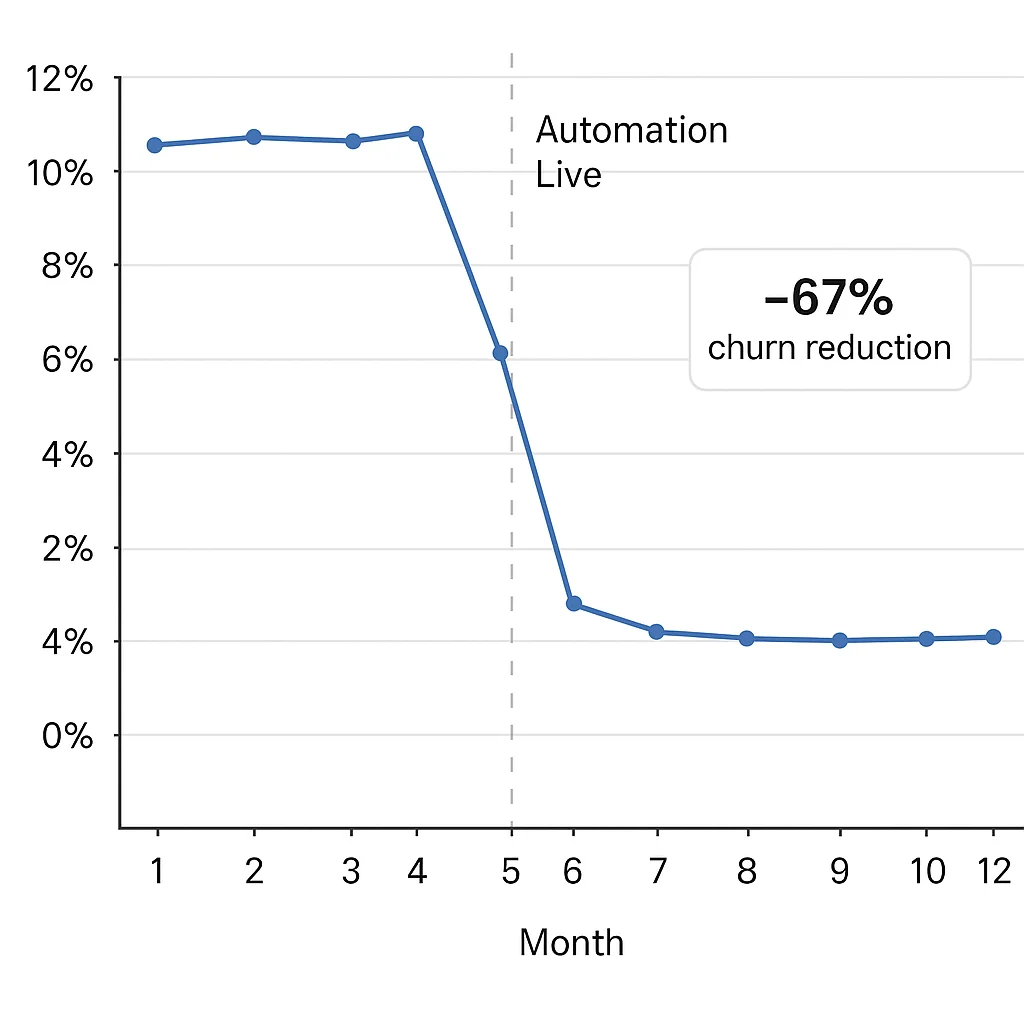
Most paid community owners focus on growth — more members, more content, more launches. Churn is the leak in the bucket they never get around to fixing. But a community losing 8% of its members every month has to replace those members just to stay flat. Fix the leak and the growth compounds automatically.
Here's how to reduce churn in a paid membership community — what the benchmarks actually look like, what drives each type of churn, and the specific automations that address each cause.
What is a good churn rate for a paid membership community?
Most community operators don't know what "normal" churn looks like, which makes it hard to know whether they have a problem. Here are realistic benchmarks by tier and niche:
| Community Type | Typical Monthly Churn | Well-Managed Churn | Churn Risk Level |
|---|---|---|---|
| Gaming / entertainment | 12–18% | 8–10% | High — interest-driven |
| General interest / education | 8–12% | 5–7% | Medium — outcome clarity matters |
| Trading signals / finance | 5–9% | 3–5% | Low when ROI is visible |
| Business / operator mastermind | 4–7% | 2–4% | Low — high ticket, high retention |
| Fitness / accountability coaching | 6–10% | 3–6% | Medium — engagement-dependent |
If your churn is above the "typical" range for your niche, you have a fixable operational problem. If you're in the "well-managed" range, you're ahead of most and the gains from here are incremental. The difference between 8% and 4% monthly churn, compounded over 12 months on a $10,000 MRR community, is roughly $24,000 in retained annual revenue.
Why members churn — the real reasons
Exit surveys from paid communities consistently point to the same handful of reasons. Not one of them is "too expensive."
Didn't get value fast enough. A member who doesn't have a meaningful experience in their first 7–14 days is an extremely high churn risk. The excitement of joining fades quickly if it isn't reinforced by real value.
Felt lost or uninvolved. Members who don't know where to go, what to do first, or how to participate quietly disengage. Then they cancel at the next renewal.
Stopped showing up and never came back. Life gets busy. Members miss a week, then two. By the time they're a month removed, they've mentally cancelled even before they hit the button.
Payment failed silently. Their access disappeared and they assumed they'd been removed or the community had ended. They moved on without trying to recover.
Each of these is addressable with automation. None require a price cut.
Fix churn in the first 14 days with automated onboarding
First-month churn is almost entirely an onboarding problem. Members who don't get oriented and engaged in the first two weeks are gone by month two. Communities running a structured onboarding sequence see 20–35% lower first-month churn than those with no onboarding at all.
The automated onboarding sequence that meaningfully reduces early churn:
Day 0: Welcome DM via Discord with explicit orientation — the three channels to visit first, the one action to take today, and who to contact with questions. Not a wall of information. Three specific things.
Day 1: A follow-up DM checking they've found what they need. Ask one question that prompts a response — new members who reply in the first 24 hours have significantly higher 90-day retention.
Day 3: Point them to the highest-value content a new member hasn't discovered yet. A specific recommendation, not a general nudge toward the resource library.
Day 7: A community participation prompt — introduce yourself in #introductions, share your biggest challenge, answer a question someone else posted. Create a reason to show up and contribute.
Day 14: A mid-month check-in. How's it going? What have you found most useful? This can come from your own email address in your own voice and catches quietly at-risk members before the first renewal hits.
Identify at-risk members before they cancel
Churn prediction doesn't require expensive analytics software. In a Discord community, disengagement is visible: members who haven't posted, haven't reacted, haven't been seen. A scheduled n8n workflow running weekly can flag anyone who meets your at-risk criteria.
The dual signal that reliably predicts churn:
- No Discord activity in the past 14 days
- Subscription renewal approaching within 7 days
When a member hits both criteria, the workflow fires an automated re-engagement DM: "Hey [Name] — noticed you've been quiet lately. Wanted to check in. Anything you need help finding or anything we could be doing better for you?"
That message — personal in tone, non-pressuring — gets a response rate that justifies the entire system. Members either reengage or tell you why they're thinking of leaving. Both outcomes are useful.
Reduce involuntary churn with a dunning sequence
Involuntary churn — members lost to failed payments rather than active cancellations — accounts for 20–40% of total churn in most subscription communities. Stripe estimates 9% of subscription revenue is at risk from card failures in any given month. Without a dunning sequence, most of that converts to permanent loss.
An automated dunning sequence:
- Day 0: Payment fails — immediate Discord DM and email sent
- Day 2: Follow-up reminder with card update link
- Day 4: Final warning before access removal
- Day 5: Role removed, offboarding message sent
Communities with this sequence recover 60–70% of failed payments that would otherwise have churned permanently. This is the highest-ROI single automation to build — it runs silently in the background and pays for itself every month. See the full setup in our Discord community automation guide.
Give members a reason to stay at renewal
The renewal moment is a natural churn point. A member who hasn't thought about your community in a few weeks sees the charge on their card and makes a split-second decision: keep it or cancel.
Intercept that moment. A pre-renewal sequence pulling from Stripe subscription data via n8n fires 7 days before each member's renewal date. It doesn't need to sell — it needs to remind them of the value they've received and what's coming next. A simple two-email sequence at Day -7 and Day -2 reduces renewal churn by 15–25% for communities that run it consistently.
Make it easy to pause, not just cancel
Some churn is temporary. A member is going through a busy period, travelling, changing jobs. They don't want to leave permanently — they just need a break. If cancellation is the only option, you lose them permanently. If you offer a pause, you keep them.
Stripe's subscription pause feature suspends billing for a defined period while keeping the subscription active. Build a link to this option into your cancellation DM and pre-renewal sequence. Members who might have cancelled often take a pause instead, and the majority of paused members return when their circumstances change.
Track churn by cohort so you know what to fix
You can't improve what you're not measuring. The most useful churn metric isn't your overall average — it's churn broken down by join cohort. Members who joined during a particular launch campaign may churn at 3x the rate of organic members, which tells you something specific about the expectation gap between what attracted them and what they found.
n8n can automate cohort tracking: on every cancellation event, log the cancellation date, join date, and original acquisition source to Airtable. A simple table view gives you cohort churn rates at a glance and tells you exactly where to focus retention effort first.
Reducing churn by even 2 percentage points per month compounds significantly over a year. On a $10,000 MRR community, getting from 8% to 6% monthly churn is worth roughly $2,000 in additional retained revenue per month — every month, permanently. If you want the retention automation built for your community, book a free strategy call.