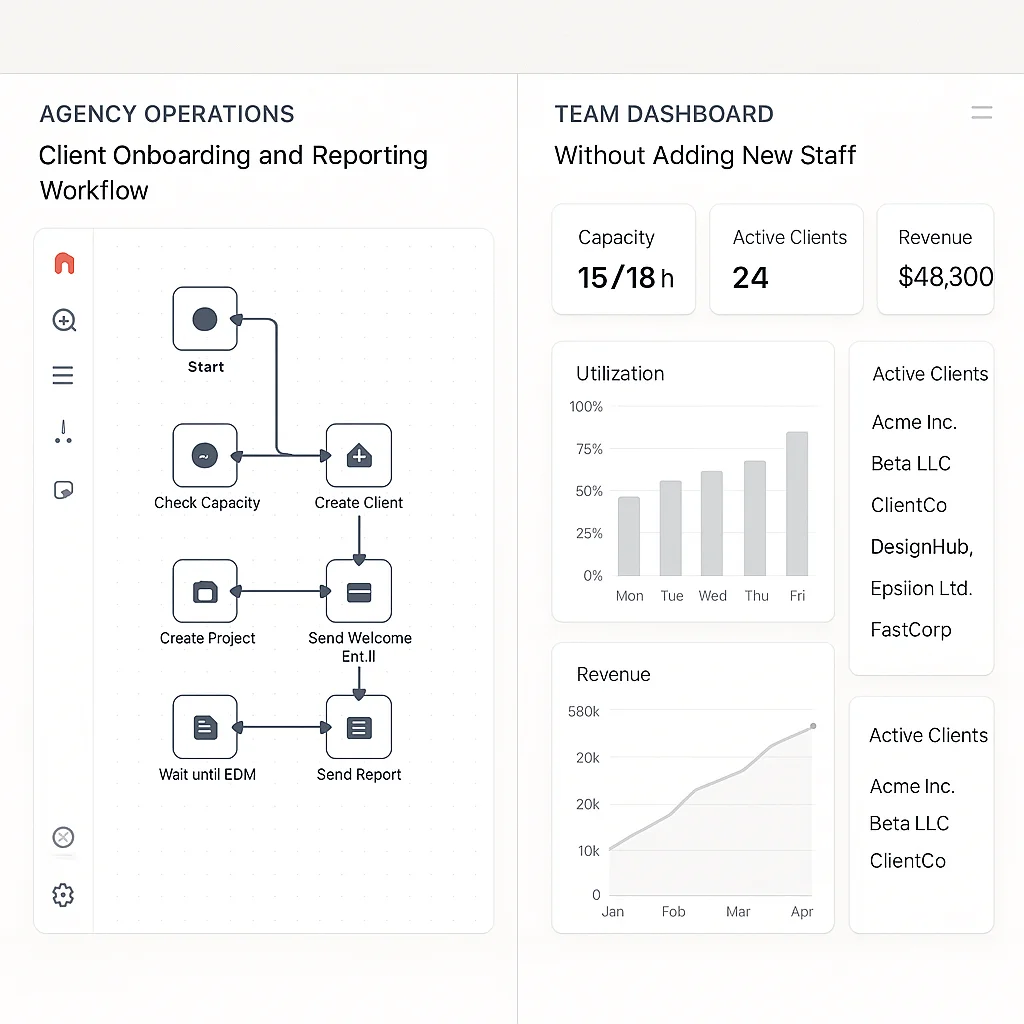
Your team spent hours this week on client reporting. None of it was billable. Someone manually sent a project update that your project management tool should have sent automatically. A new client waited two days for onboarding because the account manager was on another call.
This is what operational overhead actually looks like at a growing agency — not one big problem, but a hundred small ones that collectively eat 20–30% of your capacity.
Workflow automation eliminates it. Here's exactly where to start and what to build.
The highest-impact automations for agencies
Client onboarding
Client onboarding is the single most time-consuming manual process in most agencies. When a contract is signed or a payment lands, someone has to create the project folder, send welcome materials, schedule the kickoff call, provision tool access, and brief the team. If one person does this, it takes 2–3 hours. If it falls between people, steps get missed.
An automated onboarding flow handles all of it the moment the trigger fires — contract signed in DocuSign, payment confirmed in Stripe, or project created in your PM tool. The client gets a professional welcome within 60 seconds. Your team gets a briefing notification. Nobody does it manually.
One of our clients — a 6-person UK marketing agency — was spending 4 hours per new client on onboarding. After automation, that dropped to 15 minutes of actual human time, used only for the kickoff call itself.
Automated reporting
Most agencies pull data from Google Ads, Meta, GA4, and their CRM separately, then paste it into a report template, then format it, then send it. Every week. For every client.
With n8n, a scheduled workflow pulls data from every platform at once, formats it into your report template, and delivers it to the client automatically. The first setup takes a few hours. After that, it runs without you.
The agencies doing this aren't spending less time on reporting — they've eliminated it entirely as a staff task.
Lead follow-up
Agencies are consistently bad at following up with leads — not from lack of intent, but because it requires someone to remember. When a lead fills in a contact form, books a discovery call, or replies to an outreach sequence, they should enter an automated follow-up flow immediately.
Confirmation email sent. Reminder before the call. Post-call follow-up. Nurture sequence if they don't convert. All of it triggered automatically, no one needing to think about it.
We built this for a London agency that was converting 8% of discovery calls. Within 60 days of consistent automated follow-up, that number was 23%. The leads hadn't changed. The follow-up had.
Project handoffs and team notifications
When a deliverable is completed in your PM tool, the next person in the chain needs to know immediately. When a milestone is hit, the client should hear about it before they have to ask. When a deadline is approaching and the task is still open, someone needs a nudge.
None of this requires a human — it requires a workflow that watches your PM tool and fires the right notification at the right time.
Invoicing and payment collection
For agencies on retainers, invoicing is a monthly ritual that should require zero human effort. Generate the invoice, send it, chase it if unpaid, update your accounting system when it clears. All automated. All consistent. No one on your team touching it unless there's a genuine exception to handle.
The tool we use: n8n
n8n is the automation engine behind every workflow we build at ShipWorkflow. It connects to every tool in your agency stack — HubSpot, Pipedrive, Asana, ClickUp, Slack, Xero, QuickBooks, Google Ads, Meta — and orchestrates actions between them based on triggers you define.
We use it over Zapier because it's dramatically cheaper at agency scale, supports complex conditional logic, and can be self-hosted so your client data stays on your infrastructure. At 10,000+ tasks a month, n8n runs for a fraction of what Zapier would cost.
How to prioritise your first automations
The mistake most agencies make is trying to automate everything at once. Start with the workflow that costs the most hours and has the clearest, most repeatable process — then automate that one first.
The sequence that works for most agencies:
- Client onboarding — highest time cost, biggest impact on client experience
- Lead follow-up — directly measurable revenue impact
- Reporting — high recurring time cost, completely repeatable
- Invoicing — reduces errors, improves cash flow
- Internal ops — project handoffs, team notifications, contractor onboarding
Get the first two working properly before adding complexity. A stable onboarding and follow-up system running on autopilot is worth more than five half-finished automations.
What to expect
Across the agency clients we've worked with, a full automation system typically delivers a 20–40% reduction in time spent on non-billable work. For a 10-person agency, that's the equivalent of 2 full-time staff redirected to billable output — without any new hires.
Client onboarding goes from days to minutes. Lead conversion improves from consistent follow-up. Reporting errors drop to near zero. And the operational ceiling that used to force you to hire before you could grow gets removed entirely.
If you want to understand what this looks like for your specific agency, book a free strategy call. We'll map your current processes, identify your highest-impact automation opportunities, and give you a clear picture of what we'd build and what it would save you.