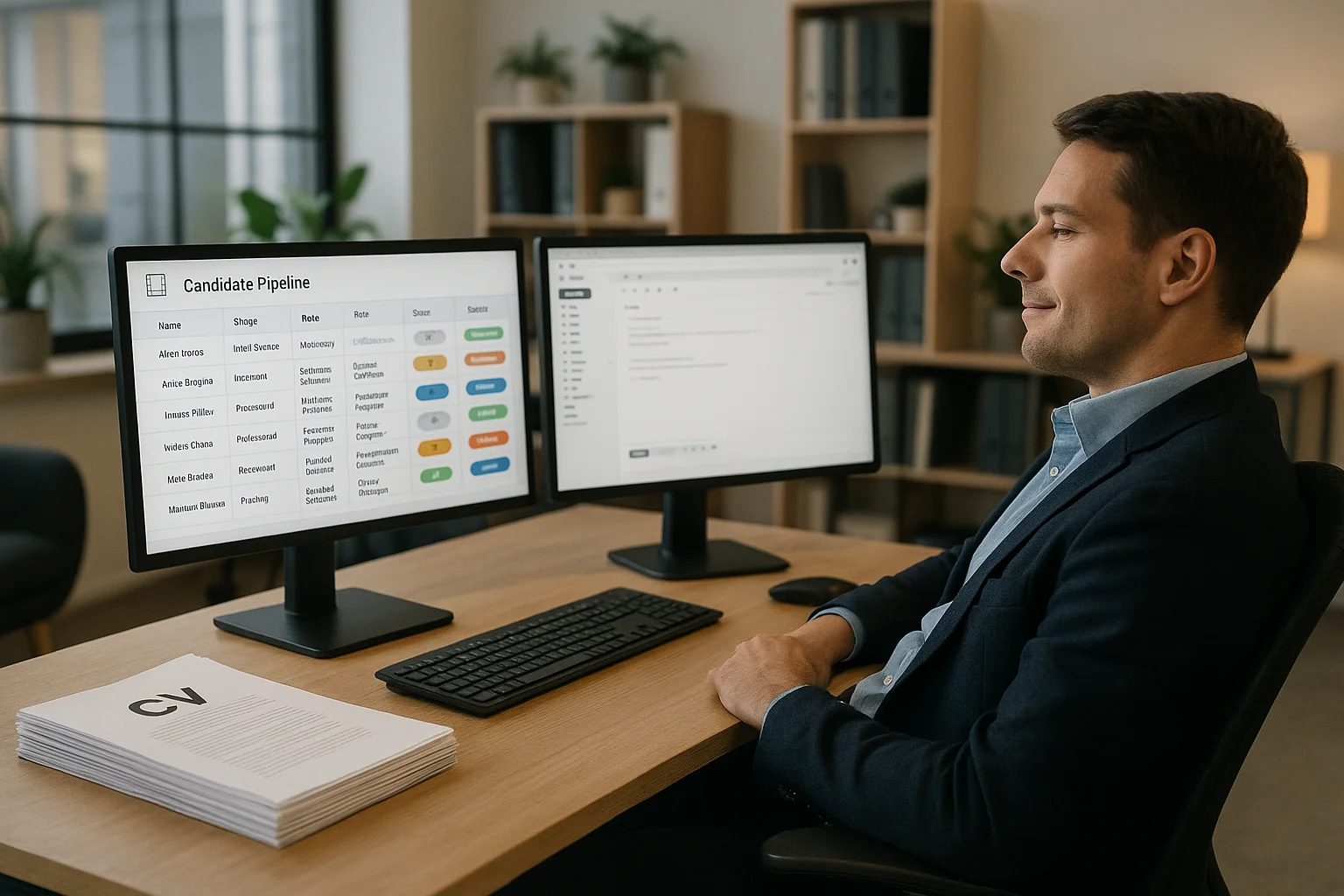
A London recruitment agency came to us with a straightforward problem: they were growing, but their operations weren't. Every new client meant more manual work — CVs processed by hand, candidate scoring done in spreadsheets, client updates sent manually, placement tracking maintained across three different systems.
Their ops manager was spending 35 hours a week on administration. They were turning away new business because they didn't have the operational capacity to handle it without hiring.
Here's what we built, and what changed.
The before: where the time was actually going
Before we mapped their processes, they described their problem as "too much admin." When we broke it down, it was five distinct manual workflows, each with its own bottleneck:
CV processing. Every CV received by email was manually read, scored against the role criteria, and added to a spreadsheet. For an active role with 40+ applicants, that's hours of work before a single candidate is contacted.
Candidate communications. Every stage update — acknowledgement, interview invite, rejection, offer — was drafted and sent manually. For 10 active roles with 20+ candidates each, this was constant context-switching.
Client reporting. Clients expected weekly pipeline updates. The ops manager spent 3–4 hours every Friday pulling data from the candidate spreadsheet and writing bespoke update emails for each client.
Placement tracking. Once a candidate was placed, recording the placement, calculating the fee, updating the client record, and raising the invoice all happened manually across multiple systems.
Compliance and documentation. Right-to-work checks, reference requests, and contract generation were triggered manually when a placement was confirmed — creating delays and occasional missed steps.
None of these required human judgement. All of them were consuming human time.
What we built
Automated CV parsing and scoring
CVs now flow into a centralised inbox monitored by n8n. When a CV arrives, the workflow parses it using an AI extraction layer, pulls out the key data points (experience, skills, location, current role), and scores the candidate against the active role's criteria.
Candidates above the threshold get an acknowledgement email immediately and are added to the active pipeline in Airtable. Those below threshold receive a polite decline within minutes of applying. The ops manager reviews the scored pipeline — not the raw CVs.
CV processing time per role: from 6–8 hours to under 30 minutes of human review time.
Candidate communication sequences
Every stage of the recruitment pipeline now has automated communications. When a candidate moves to interview stage in Airtable, n8n fires automatically: interview confirmation email to the candidate, briefing email with the candidate's profile to the client, calendar invite to both parties.
When a candidate is rejected, a personalised decline email goes out the same day — not days later when someone gets around to it. When an offer is made, the offer letter template is populated and sent automatically.
None of these required new copy — they used the agency's existing templates, now triggered automatically rather than manually.
Automated client pipeline reports
Every Friday at 8am, n8n queries each client's active roles in Airtable, pulls the current pipeline status, formats it into a structured update, and emails it directly to the client contact. The format is consistent, the data is current, and no one in the agency spends time on it.
The ops manager now spends Friday mornings on billable work instead of report writing.
Placement processing and invoice generation
When a candidate is marked as placed in Airtable, a workflow triggers: the placement is logged with date and fee, an invoice is generated from the template and sent to the client via Xero, the candidate record is updated, and a notification goes to the director with placement summary and projected revenue impact.
End-to-end placement processing went from 45 minutes to under 5 minutes of human involvement — just the Airtable status update.
Compliance workflow
On placement confirmation, the system automatically requests right-to-work documentation from the candidate, sends the reference request emails, and flags the compliance checklist for the relevant team member. No steps get missed because no one has to remember them.
The results
Six weeks after the system went live:
- Admin time dropped from 35 hours to 9 hours per week — the remaining 9 hours covering work that genuinely requires human judgement
- Candidate response time improved from 2–3 days average to same-day for all stages
- Client reporting went from 4 hours of manual work to zero — fully automated
- The agency took on 3 new client accounts in the following month without adding any operational headcount
- Invoice accuracy improved — no more manually calculated fees or missed placements
The director's summary: "We're now doing 40% more placements with the same team."
What this means for your recruitment agency
If your ops team is spending significant time on CV handling, candidate updates, client reporting, and placement admin, the operational ceiling you're hitting isn't a people problem — it's a systems problem.
Every hour your team spends on repeatable administration is an hour not spent on sourcing, relationship management, or business development. That's the real cost.
The system we built for this client runs on n8n, Airtable, Xero, and their existing email platform. No new tools the team had to learn. No processes that changed how they worked. Just the manual steps removed.
If you want to talk through what this looks like for your agency, book a free strategy call. We'll map your current ops and show you exactly where automation applies.