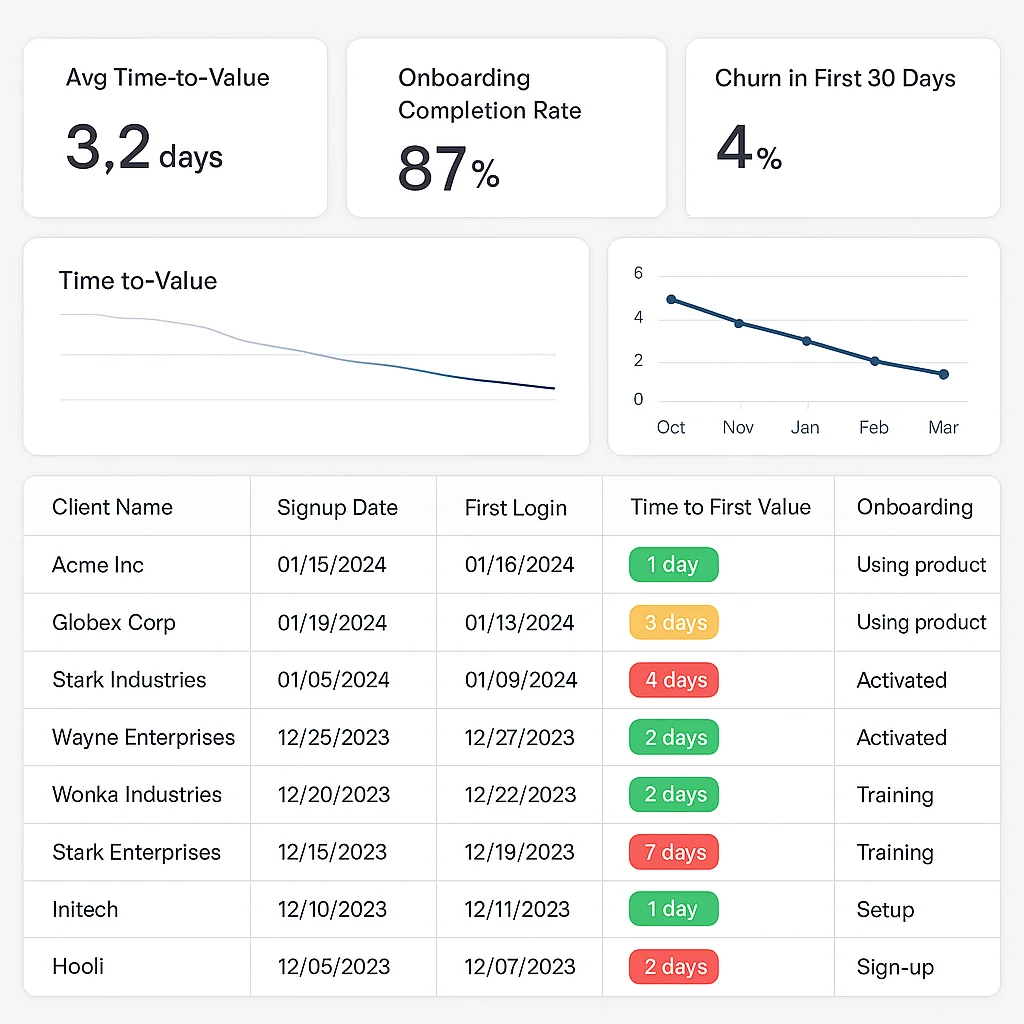
Time-to-value is the single metric that predicts early SaaS churn better than any other. Customers who reach their first meaningful outcome within the first few days stay. Customers who don't — regardless of how much they paid — quietly stop logging in and cancel at the first renewal.
Most SaaS companies know this. Few have systematically done anything about it. Here's what actually moves the number.
What time-to-value actually means
Time-to-value is the gap between a customer signing up and the first moment they experience a specific, tangible benefit from your product. Not "they logged in." Not "they completed the setup wizard." The moment they got something real from it.
That definition varies by product. For a project management tool, it might be the first time a project is created with tasks assigned and a teammate notified. For a reporting tool, it's the first time a report is generated with real data. For a community platform, it's the first meaningful interaction with another member.
Defining your first value moment precisely is the prerequisite for reducing time to reach it. If you don't know what you're trying to get customers to, you can't optimise the path.
The four levers that reduce time-to-value
1. Faster provisioning
If there's any delay between payment confirmation and a fully usable account, you're starting behind. Every minute a customer spends waiting to access the product they just paid for is a minute of eroding confidence.
Automated provisioning via n8n calls your account setup API the moment a payment or signup event fires. Account created, workspace configured, permissions set — before the customer finishes reading the confirmation email. This single change reduced time-to-first-login by 70% for one SaaS client we worked with.
2. A welcome sequence that leads, not informs
The most common onboarding mistake is sending a feature tour when a new customer needs a directed path. A feature list tells them what exists. A directed path tells them exactly what to do first to get value.
The welcome email should contain one action — the single thing that gets a new customer to their first value moment fastest. One link. One CTA. Nothing else competing for attention.
3. Milestone-triggered nudges
Static time-based sequences — "Day 3 email, Day 7 email, Day 14 email" — send the same message to every customer regardless of where they actually are in their journey. A customer who completed setup in 20 minutes gets the same Day 3 nudge as a customer who hasn't logged in since signing up. That's wasted relevance.
Milestone-triggered sequences fire based on what the customer has actually done. Complete the first action → immediate confirmation and next step. Stall at Day 3 without completing the first action → re-engagement email with a different angle and a direct offer to help. n8n queries your product database to evaluate each customer's state before each email fires.
4. Human escalation for stalling customers
Some customers need a human touch to get past a stall. Automation's job is to identify them and escalate — not to keep sending automated emails to someone who's stopped engaging with them.
An n8n workflow monitoring daily engagement data fires a Slack alert to the relevant account manager when a customer hits a stall threshold — no login in 3 days during trial, setup incomplete after Day 5, first value milestone not reached by Day 7. The alert includes everything the account manager needs to make an informed personal outreach: usage data, where they got stuck, what they last did.
Measuring the improvement
Track time-to-value as a named metric in your CRM. n8n can automatically record the timestamp when each customer hits their first value milestone (pulled from your product events) and calculate the gap from signup. Over time, you have a trend line showing whether your onboarding changes are actually moving the number.
One SaaS client tracked their average time-to-first-value at 8.3 days before automation. Six months after implementing milestone-triggered sequences and automated provisioning, it was 2.1 days. Their 30-day churn rate dropped from 22% to 11% over the same period.
If you want to build the system that drives that improvement, book a free strategy call. We'll define your first value moment, map the current path to it, and build the automation that shortens it.