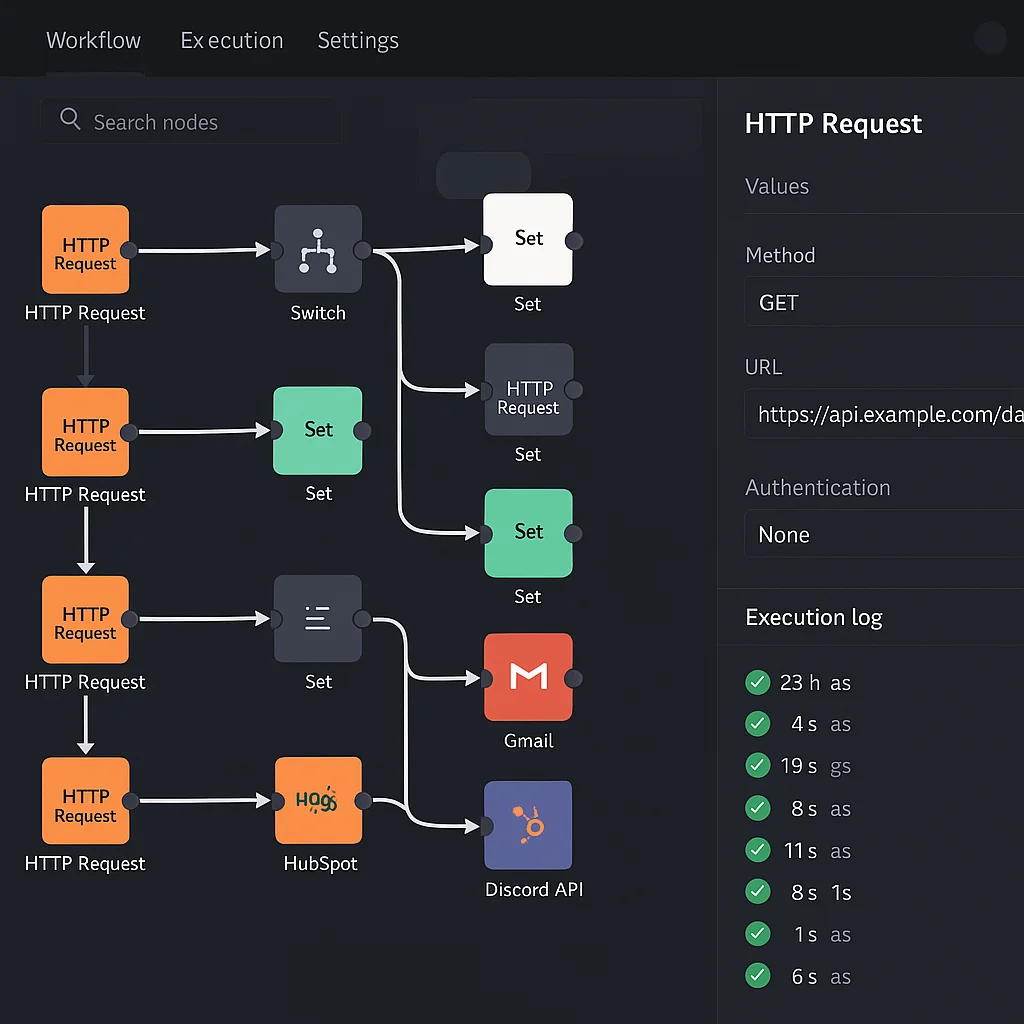
n8n is powerful. It's also a tool that rewards experience — the difference between a workflow built by someone who's done it dozens of times and one built by someone learning on the job shows up in production, not in testing.
Here's what to look for when hiring an n8n developer, and what separates someone who can build a workflow from someone who can build a system.
What an n8n developer actually does
An n8n developer designs and builds automation workflows that connect your tools, eliminate manual work, and run reliably without supervision. The technical work involves:
- Designing the workflow architecture — what triggers what, how edge cases are handled, where data is stored
- Configuring webhook endpoints and API integrations for your specific tools
- Writing custom JavaScript or Python inside workflow nodes where native integrations don't cover the logic you need
- Building error handling and alerting so failures are caught and flagged immediately
- Setting up n8n itself — cloud or self-hosted, depending on your data requirements
- Testing thoroughly with real data before anything goes live
- Documenting what was built so you understand it and can maintain it
The last two points — thorough testing and documentation — are where inexperienced developers cut corners. A workflow that works in testing with clean data and fails with real-world edge cases is worse than no automation, because it fails silently and corrupts your data while doing so.
Questions to ask before hiring
Can you show me workflows you've built in production? Anyone can screenshot a tutorial workflow. Ask to see something real — ideally with multiple branches, error handling visible, and a description of what it does. The complexity of what they show you tells you their ceiling.
How do you handle errors? The correct answer involves error trigger nodes, alerting to Slack or email, and logging failed executions. If the answer is "n8n shows you in the execution log," they haven't built anything serious in production.
How do you verify Stripe webhooks? Any developer building payment automations should be doing signature verification on every incoming webhook. If they don't know what this means, they're building security vulnerabilities into your payment flows.
Do you self-host or use n8n cloud? There's no wrong answer, but they should understand the trade-offs — cost, data ownership, maintenance overhead — and be able to recommend the right setup for your situation.
What do you deliver at handoff? The answer should include documentation, a walkthrough, and ideally a brief period of post-launch monitoring. If the answer is just "the workflow," you'll be on your own when something needs adjusting.
Freelancer vs agency
A freelance n8n developer is the right choice for a single, well-scoped workflow — one integration, one automation, clearly defined. Cheaper upfront, faster to start, but limited capacity if scope grows or you need multiple workflows built simultaneously.
An n8n automation agency is the right choice when you need a system — multiple interconnected workflows, ongoing support, someone who's accountable when something breaks six months after build. You're paying for infrastructure thinking, not just workflow execution.
What we do at ShipWorkflow
We build n8n automation systems for agencies, paid communities, SaaS companies, and eCommerce brands. Every project starts with architecture design — not just building what you ask for, but designing what you actually need. Every workflow includes production-grade error handling, testing with real data, and full documentation at handoff.
Building automations that call OpenAI or other AI APIs? Use our free OpenAI Pricing Calculator to estimate token costs before you scope the build.
If you have a specific automation project in mind, book a free strategy call. We'll scope it, tell you what it involves, and give you a clear picture of what it would cost and how long it would take.