Hiring to solve an operations problem is expensive, slow, and temporary. The person you hire fills the gap today and creates a dependency tomorrow — on their knowledge, their availability, and their decision to stay.
A properly built automation system solves the same problem permanently. Here's what working with an automation agency actually involves, and how to know if it's the right move for your business.
What an automation agency does
An automation agency designs and builds the systems that connect your tools and eliminate the manual work sitting between them. The output isn't software you buy — it's infrastructure built specifically for how your business operates, using the tools you already have.
The work covers three phases:
Discovery and architecture. Before anything is built, the agency maps your current processes — what happens manually, what the triggers are, where data moves between tools, and what breaks or gets missed. From that map, they design the automation architecture: which workflows to build, what order to build them in, and how they connect.
Build and testing. Workflows are built in n8n or Make, tested with real data, and stress-tested against edge cases. This phase includes error handling and alerting so the system is production-ready before it goes live — not tested in production at your expense.
Handoff and support. The client receives full documentation, a walkthrough of what was built and how it works, and a period of post-launch monitoring. A good automation agency doesn't disappear after delivery.
When it makes sense to hire an automation agency
An automation agency is the right choice when:
- You have multiple manual processes that need automating, not just one — a single workflow is usually better handled by a freelancer
- The workflows involve sensitive data that needs to stay on your own infrastructure
- You need the system to work reliably in production, not just in theory — experience with error handling and edge cases matters
- You want ongoing support as your business grows and new automation needs emerge
- You don't have internal technical resource to build and maintain it yourself
If you're an agency trying to automate client onboarding, reporting, and lead follow-up simultaneously — that's a system, not a single workflow. An agency builds the whole thing cohesively.
What to look for
Proof of production builds. Ask to see real workflows they've built, not screenshots of tutorial demos. The complexity of what they can show you is the ceiling of what they can build for you.
A clear discovery process. Any agency that quotes before mapping your processes hasn't understood your problem. The discovery call should result in a detailed scope, not just a price.
Error handling as standard. Ask specifically how they handle workflow failures. The answer should involve error trigger nodes, immediate alerting, and logging. If they say "n8n tracks executions," they haven't built serious production systems.
Documentation in the deliverable. You should understand what was built. If the agency is the only one who understands how your automation works, you have a dependency problem, not a solution.
What ShipWorkflow builds
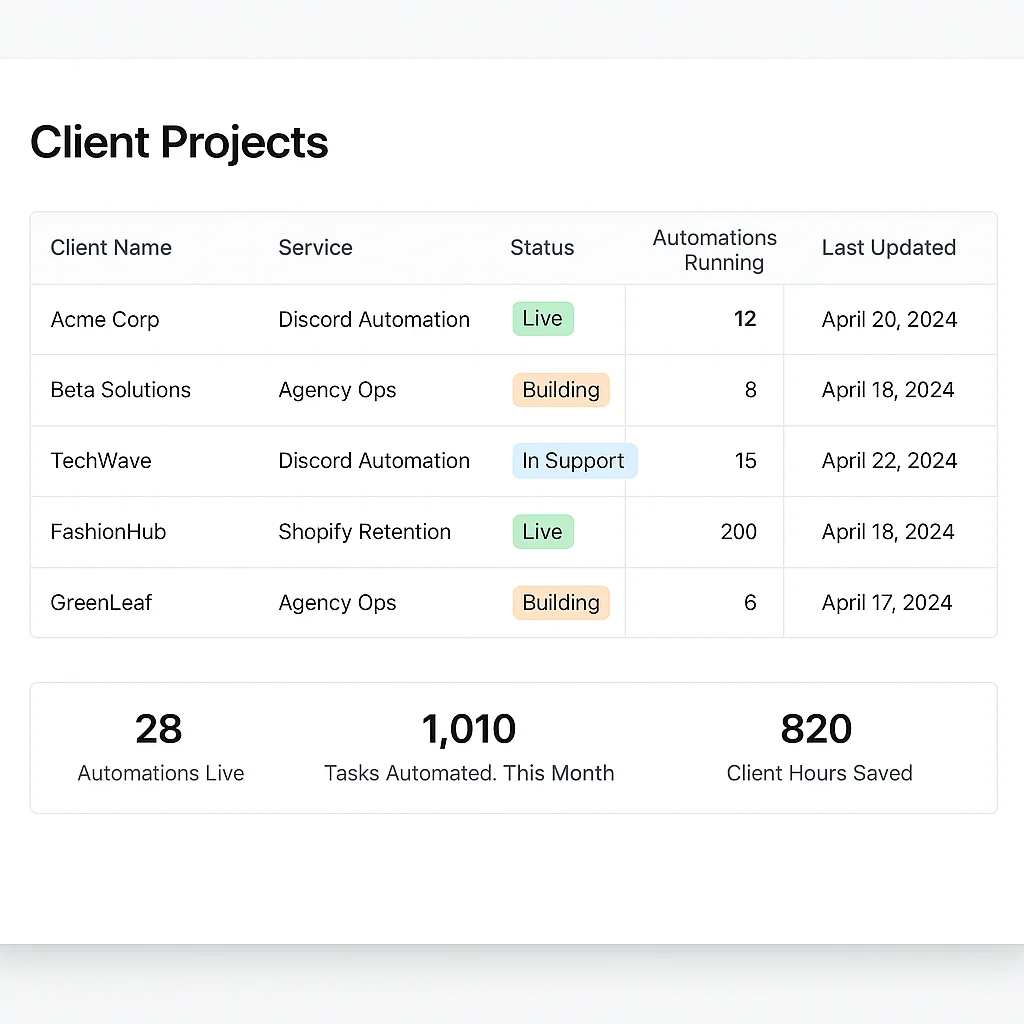
We're a UK-based automation agency building on n8n for agencies, paid communities, SaaS companies, and eCommerce brands. Our most common projects: agency operations automation (onboarding, reporting, lead pipelines), paid community infrastructure (Stripe, Discord, Skool), and custom internal tools that replace spreadsheet-based workflows.
Every project includes architecture design, production-grade error handling, testing with real data, full documentation, and a post-launch support period.
Book a free strategy call to discuss what your business needs and what we'd build.