Most eCommerce brands focus almost entirely on acquisition — ad spend, influencer campaigns, SEO. The margin is made on the back end, and most of the back end is underbuilt.
A properly built eCommerce revenue system connects your acquisition with your retention so that every customer you pay to acquire generates significantly more lifetime revenue than your current numbers suggest is possible. Here's what that system looks like and what it actually produces.
What an eCommerce revenue system is
An eCommerce revenue system is the infrastructure that maximises revenue from every customer interaction — before, during, and after the first purchase. It's not a single tool. It's a connected stack: Shopify for the store and order data, Klaviyo for email and SMS, n8n for the automation layer that connects everything and handles logic that native integrations can't.
The three pillars:
Pre-purchase: Abandoned cart recovery, browse abandonment, and back-in-stock alerts that capture intent before it leaves your site.
Post-purchase: A structured sequence that moves every customer from first-time buyer to repeat purchaser — confirmation, product education, cross-sell, and replenishment.
Retention: Win-back campaigns for lapsed customers, VIP programmes for high-LTV customers, and churn prevention for subscription products.
Most brands have some version of these. Few have all of them built to the standard that generates 25–40% of total revenue from email alone.
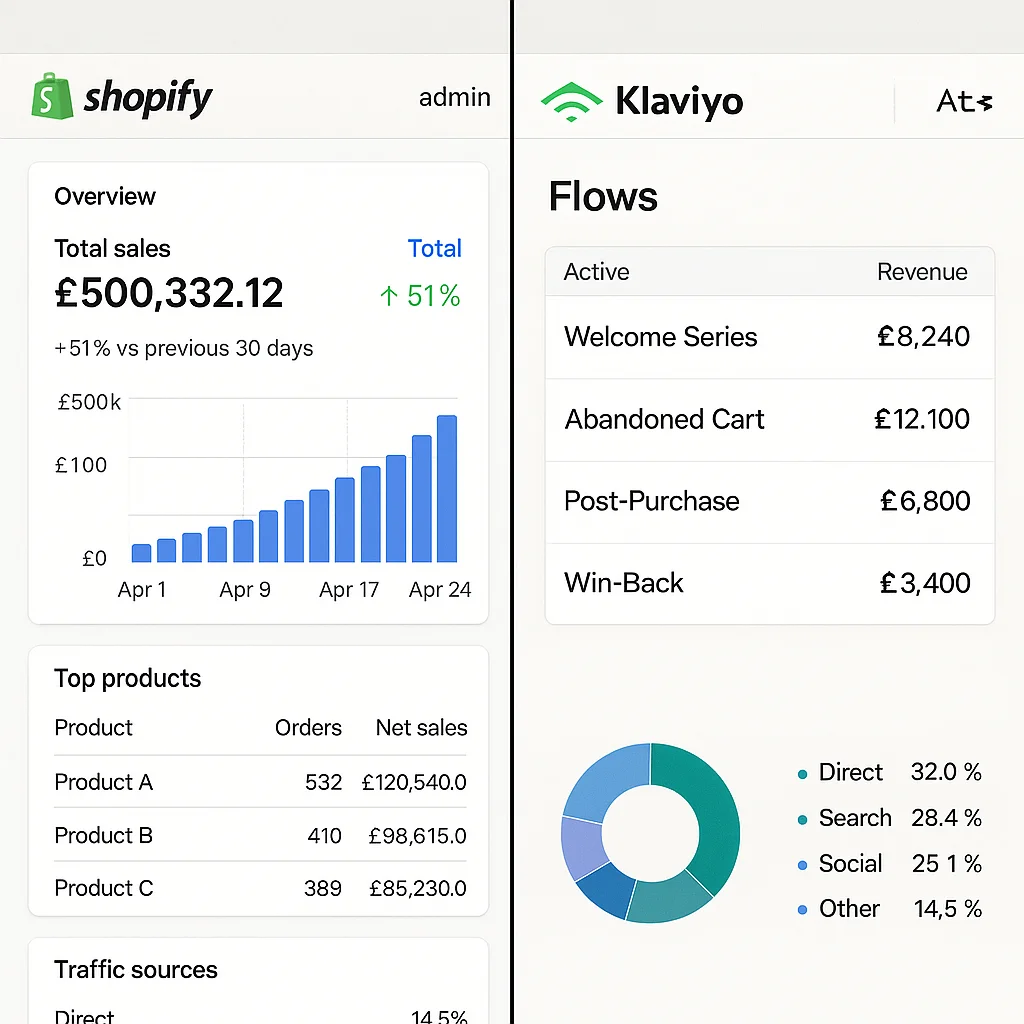
A real example: £500k/month supplement brand
A UK supplement brand came to us with solid acquisition — Meta ads and Google performing well, strong ROAS on cold traffic. Their email programme was generating 11% of revenue. Industry standard for a well-run brand in their category is 30–35%.
The gap was in their retention infrastructure. They had a single abandoned cart email and a basic welcome series. Post-purchase was a single order confirmation. Win-back didn't exist. Their repeat purchase rate was 22% — low for a consumable supplement product where the natural cycle should be driving it to 45%+.
We built the full system over six weeks:
- Three-email abandoned cart flow with objection handling in email two
- Post-purchase sequence: confirmation, Day 3 check-in, Day 10 product education, Day 30 replenishment prompt, Day 45 cross-sell based on first product purchased
- VIP segment trigger at £250 lifetime value — separate, premium-tone email sequence and early access to new products
- Win-back campaign for customers with no purchase in 90 days — three emails over 30 days with a reason to return
- Browse abandonment for high-value product pages — two-email sequence 24 hours apart
Six months later: email revenue as a percentage of total was 31%. Repeat purchase rate was 38%. Monthly revenue had grown to £500k, with email responsible for £155k of it — up from £55k before the system was built.
The n8n layer
Klaviyo handles the email sequencing and sends. n8n handles the logic that Klaviyo's native integrations can't. Specifically:
- Routing customers into the correct post-purchase sequence based on which product they bought (Klaviyo can do basic segmentation, but complex product-based routing is cleaner in n8n)
- Syncing Shopify subscription data to update Klaviyo tags in real time for subscription brands
- Triggering the VIP segment update based on Shopify lifetime value calculations that run daily
- Firing Slack notifications to the team when a win-back customer converts — so they can be flagged for elevated service
The Klaviyo + n8n combination is the most effective eCommerce email stack we've found. Klaviyo for the front-facing email experience, n8n for the data orchestration and logic layer behind it.
If you want your eCommerce revenue system built properly, book a free strategy call. We'll audit what you have, identify the gap versus what's possible, and build the system that closes it.