Most eCommerce brands spend their first year focused on acquisition — ads, influencers, SEO. Then they hit a wall: CAC is rising, ROAS is declining, and the economics of new customer acquisition are no longer working the way they used to.
The brands that scale past that wall share one thing: their email retention infrastructure is properly built. Abandoned cart flows, post-purchase sequences, win-back campaigns, browse abandonment — all running automatically, generating revenue from customers they've already paid to acquire.
Here's how to build the four core ecommerce email flows in Klaviyo and Shopify, which order to set them up in, and what each actually generates when built correctly.
What each flow generates: at a glance
| Flow | Trigger Event | Emails in Sequence | Typical Revenue Share | Build Complexity |
|---|---|---|---|---|
| Abandoned cart | Checkout started, no purchase | 3 | 40–60% of email revenue | Low |
| Post-purchase sequence | Order placed | 5–6 | 15–25% of email revenue | Medium |
| Browse abandonment | Product viewed 3+ times, no purchase | 2 | 5–12% of email revenue | Low |
| Win-back | 90+ days since last purchase | 3 | 10–20% of email revenue | Medium |
When all four flows are live and properly segmented, email typically accounts for 25–40% of total Shopify revenue. For a brand doing $100k/month, that's $25,000–40,000 in monthly revenue from a channel with near-zero marginal cost per sale.
Which Klaviyo flow to build first
Most brands build in the wrong order. Here's the right sequence:
- Abandoned cart first. Highest immediate revenue impact, lowest setup complexity. Gets money in the door from day one.
- Post-purchase second. Protects existing customers, builds LTV, and enables the cross-sell and replenishment revenue that makes retention economics work.
- Browse abandonment third. Simple two-email flow. Captures high-intent traffic that would otherwise leave without engaging.
- Win-back last. Only valuable once you've accumulated a meaningful lapsed segment — typically 60–90 days after launch.
1. Abandoned cart flow
Between 65–70% of shopping carts are abandoned before checkout. A properly built three-email sequence recovers 5–15% of those, depending on the brand and offer.
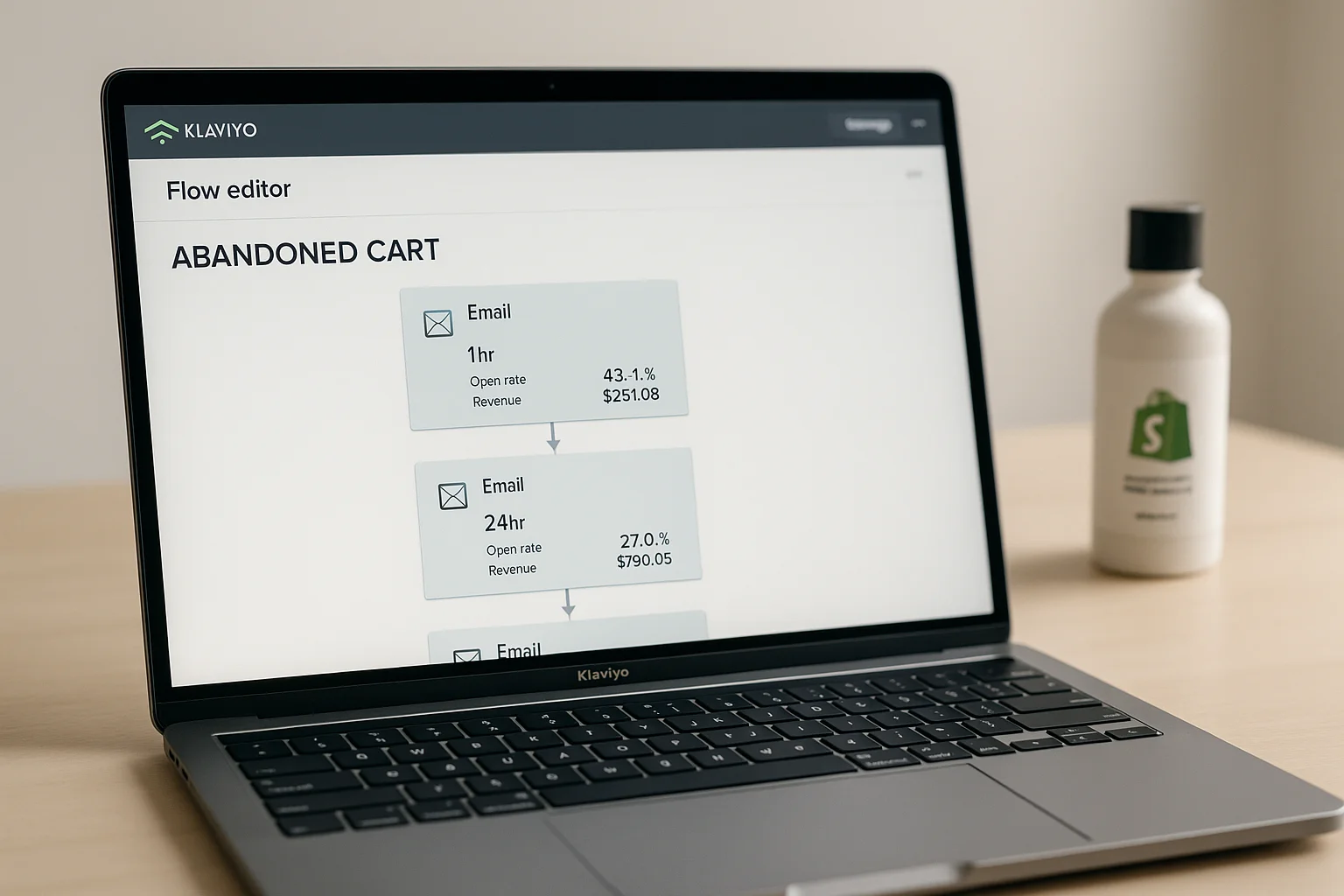
The sequence: 1 hour after abandonment (low-pressure reminder), 24 hours (address the real objection — size? delivery? price?), 72 hours (final email, small incentive if your margins allow). Three emails, not one.
The second email is where the majority of cart recovery happens. It treats hesitation as a signal to solve rather than a reason to discount. Always build all three.
In Klaviyo, trigger on the "Started Checkout" event. Add an exit condition for "Placed Order" so anyone who buys during the sequence immediately exits the flow.
2. Post-purchase sequence
The post-purchase sequence starts the moment an order is confirmed. Most brands send one order confirmation and stop. The sequence that builds retention and generates cross-sell revenue looks like this:
- Immediate: Order confirmation — transactional, builds confidence
- Shipping: Tracking notification — reduces inbound customer service questions
- Day 3 post-delivery: Product check-in. Personal tone, no sell. This is where trust is built.
- Day 10: Educational content related to what they bought. Positions the brand as more than a vendor.
- Day 21: Soft cross-sell of a complementary product based on their specific purchase
- Day 45: Replenishment prompt for consumable products (supplements, skincare, coffee)
The Day 3 and Day 10 emails are where most brands drop off because they feel non-commercial. They are also where long-term customer relationships are built — which is what makes the Day 21 cross-sell and Day 45 replenishment actually convert. Skip them and the commercial emails underperform.
3. Browse abandonment
Customers who view a product page multiple times without adding to cart are showing intent. Browse abandonment flows capture that intent before it fades.
Two emails, 24 hours apart, featuring the viewed product with social proof (reviews, bestseller label, genuine inventory scarcity) and a clear CTA. Lower volume than abandoned cart, but conversion rate on repeated browsers is strong — they are close to buying.
In Klaviyo: trigger on "Viewed Product" with a frequency filter so someone who browses 10 products in one session doesn't receive 10 separate flows. Exclude customers who've purchased in the last 30 days.
4. Win-back campaign
Every brand accumulates a lapsed customer segment — people who bought once or twice and haven't purchased in 90+ days. These customers know you, have bought from you, and have left for a reason that's often fixable.
A win-back sequence runs automatically when someone passes the 90-day mark without a repeat purchase. Three emails over 30 days: "We miss you" (reminder of value, no offer), "Here's what's new" (product update or new arrival), "Here's a reason to come back" (small incentive or bundle). The customer exits the flow immediately upon purchase.
Wait 60–90 days after launch before activating this flow. You need a meaningful lapsed segment to exist first. Building win-back for a handful of early customers is not worth the setup time.
How Shopify and Klaviyo connect
Klaviyo's Shopify integration is native and pulls in rich event data automatically — product viewed, added to cart, checkout started, order placed, order fulfilled. Every flow trigger runs off these events without custom webhook configuration.
What does require setup:
- Product catalogue sync to Klaviyo so emails can pull dynamic product blocks
- Customer segments configured correctly — active, at-risk, lapsed, VIP
- Flow filters to prevent customers from receiving multiple overlapping flows simultaneously
- UTM parameters on all email links for accurate revenue attribution in GA4
Without UTM tracking, you cannot measure how much revenue each individual flow is generating. Set this up before activating flows, or you will optimise blind.
Common Klaviyo flow mistakes
Building a single-email abandoned cart. One email catches the easy wins. The second and third emails — where real objections get addressed — are where the meaningful recovery happens.
No suppression logic between flows. A customer who just purchased shouldn't simultaneously receive your win-back campaign. Build suppression filters so flows don't overlap and send contradictory messages.
Broadcasting to your full list every time. Sending to everyone regardless of purchase history trains your best customers to ignore you and damages deliverability. Segment by recency and engagement level.
Generic cross-sell on Day 21. The cross-sell email must be based on what the customer actually bought, not your bestseller. Klaviyo's dynamic product blocks make this straightforward — use them.
Measuring open rate as a success metric. Open rate reflects subject line quality. Revenue per recipient and flow revenue generated tell you whether your email programme is actually working.
If you want your Shopify email retention infrastructure built properly, book a free strategy call. We audit what you have, identify what's missing, and build the flows that are leaving revenue on the table.