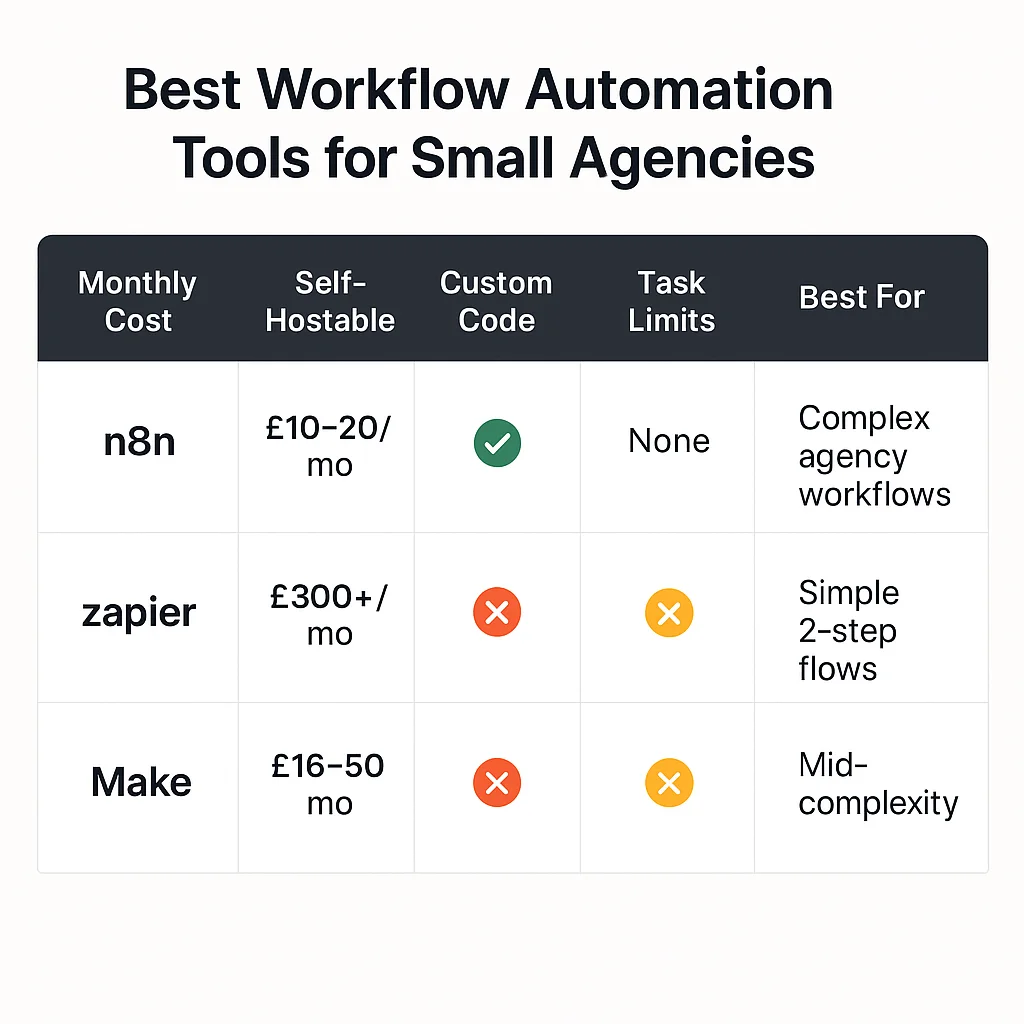
If you're a small agency trying to automate without a developer on staff, the tool you pick determines whether you save 20 hours a week or spend 20 hours fighting software. The market is full of options and most of the comparisons online are written by people who haven't actually built production workflows.
Here's an honest breakdown of the best workflow automation tools for small agencies — what each one is actually good for, where each one breaks, and which one we'd tell you to use.
What small agencies actually need from an automation tool
Before the comparison: know what you're shopping for. Small agencies typically need automation for a handful of high-value use cases — client onboarding, lead follow-up, automated reporting, invoicing, internal notifications. The tool needs to:
- Connect to the tools you already use (HubSpot, Asana, Slack, Stripe, Google Workspace)
- Handle conditional logic — if the client is on Plan A, do X; if Plan B, do Y
- Run reliably without babysitting
- Stay affordable as your task volume grows
With that frame, here are the three tools worth evaluating.
n8n
Best for: agencies that want serious automation without serious costs
n8n is an open-source workflow automation tool. You connect nodes on a visual canvas — no coding required for most use cases, though you can write JavaScript inside nodes when you need custom logic.
The cost model is what makes it stand out for small agencies. n8n charges a flat monthly fee regardless of how many workflows you run or how many tasks execute. Self-hosted (on a £5–10/month VPS) costs almost nothing to operate at scale. Zapier at equivalent task volumes would cost 5–10x more.
What it handles well: Multi-step workflows with conditional logic. Client onboarding flows that branch based on project type. Webhook-triggered automations. Direct API calls to any tool, including ones without native n8n integrations. Data transformation between incompatible formats.
Where it takes more effort: The initial setup is more involved than Zapier. You'll spend more time in configuration. For very simple two-step automations, Zapier is faster to get running. n8n's native integration library is smaller than Zapier's, though the HTTP Request node covers any gap.
Our take: For any small agency building more than five workflows, n8n is the right long-term choice. The cost savings alone justify the slightly steeper learning curve.
Zapier
Best for: simple automations, quick setup, non-technical teams
Zapier pioneered the no-code automation space and still has the largest library of native integrations — 6,000+ apps, all maintained by Zapier's team. Setup for common automations is genuinely faster than n8n.
What it handles well: Simple trigger-action flows between mainstream apps. Automations a non-technical team member can build and maintain without training. Quick connections between tools that have polished Zapier integrations.
Where it breaks down: Task-based pricing scales painfully. At 10,000–20,000 tasks/month (realistic for a small agency running onboarding, reporting, and lead follow-up simultaneously), you're looking at £300–500/month. Multi-step conditional logic is possible but clunky. Zapier doesn't support custom code, so anything requiring data transformation or API calls with custom logic hits a wall.
Our take: Right for agencies with 1–3 simple automations and low task volumes. Once you're running real systems, the cost becomes hard to justify.
Make (formerly Integromat)
Best for: mid-complexity automations with a tighter budget than Zapier
Make sits between Zapier and n8n. More flexible than Zapier — it handles iterators, routers, and more complex flow logic. More approachable than n8n for non-technical users. Pricing is operations-based (each action in a workflow counts) rather than task-based like Zapier, which works out more affordable for most agencies.
What it handles well: Multi-step flows with routing and filtering. Slightly more complex logic than Zapier without requiring custom code. A clean visual interface that teams adapt to quickly.
Where it breaks down: No self-hosting option — your data passes through Make's servers. No custom code inside workflows. At high operation volumes, costs approach Zapier territory. Less flexibility than n8n for genuinely complex use cases.
Our take: A solid middle ground if n8n's learning curve is too steep but Zapier's pricing is too high. For agencies serious about building real automation infrastructure, n8n is still the better long-term bet.
The comparison in plain terms
At 15,000 tasks/month — realistic for a small agency running client onboarding, automated reporting, and lead follow-up:
- n8n cloud: ~£20/month flat. Self-hosted: ~£5–10/month.
- Make: ~£50–80/month depending on operations.
- Zapier Professional: £350–500/month.
That cost gap compounds over 12 months and it's meaningful for a small agency.
Don't forget the AI API costs stacked on top
If your workflows call an AI model — summarizing a lead's inquiry, drafting a reply, classifying support tickets — the platform fee above is only half the bill. OpenAI, Anthropic, and Google all charge per token, separate from whatever you're paying n8n, Zapier, or Make. A single automation calling GPT-5.4 or Claude a few hundred times a day can add real monthly cost that's easy to miss when you're only budgeting for the automation platform itself.
Before you wire an AI step into a client workflow, run your expected input/output token counts through our OpenAI token pricing calculator. It compares OpenAI, Anthropic, Google, Mistral, xAI, and DeepSeek side by side so you know the actual monthly cost before you commit a client to it.
What we use at ShipWorkflow
n8n, for almost everything. We self-host it for clients who handle sensitive data. We use n8n cloud for clients who prefer managed infrastructure. The flexibility to write custom JavaScript inside nodes is something we use regularly — it's the difference between a workflow that almost works and one that handles real-world edge cases properly.
The right tool for your agency depends on your current technical comfort and your automation ambition. If you want to start simple, Zapier or Make work. If you want to build a real automation layer that runs your agency operations without growing your headcount, n8n is where you'll end up eventually — better to start there.
Looking for the bigger picture across every category, not just n8n vs Zapier vs Make? See our complete workflow automation tools guide, including open-source and AI-native options.
Building automations that call OpenAI or other AI APIs? Use our free OpenAI Pricing Calculator to estimate token costs before you scope the build.
If you want help scoping what your agency actually needs and which tools make sense, book a free strategy call. We'll map your processes and give you a straight answer.